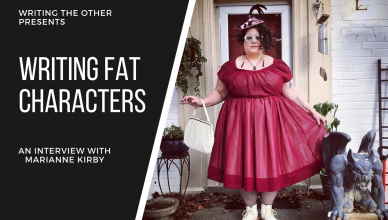
Tempest interviewed Marianne about fat characters, why she uses the term Fat, non-conforming bodies, and stereotypes to avoid and representations she’d like to see.
[...]
Julia Rios joins Tempest on Writing Excuses to talk about writing characters who come from one of the many Latin-American cultures or subcultures. There’s a LOT of discussion of food (yum!)
[...]
When writers get to the point of describing people from marginalized groups they’re sometimes filled with anxiety over the words and phrases they should use.
In this three week craft-centric class, authors Nisi Shawl and K. Tempest Bradford dive deep into these language and description pitfalls and how to avoid them.
[...]
Authors Nisi Shawl, Piper J. Drake, and K. Tempest Bradford will dive deep into character creation with writing exercises, discussion, and lectures on intersectionality, character relationships, avoiding stereotypes and tropes, and depicting characters from different genders, sexualities, classes, ethnicities, ability levels, and religious backgrounds.
[...]
This year, Writing the Other is offering four deep dive courses covering every top-level issue authors face when they set out to write inclusive, diverse fiction: creating characters who aren’t stereotypes, avoiding offensive language in description, crafting dialect and dialogue that doesn’t read like caricature, and building inclusive worlds. Combined, these four classes have all the content of our original Writing the Other Online courses plus more lectures, writing exercises, and resources.
[...]
Partially deaf and partially blind writer and editor Elsa Sjunneson walks writers through the process of researching and understanding both conditions for fiction writing.
[...]
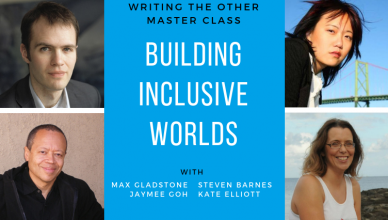
Worldbuilding for speculative fiction can be a daunting task, even moreso for authors who want to create inclusive cultures filled with diverse characters. This Master Class offers writers a deep dive into four key aspects of building inclusive worlds.
[...]
Trans playwright Ashley Lauren Rogers provides writers with an understanding of gender identity, biological sex, appropriate language (including pronouns), transitioning, and why accurate representation of trans and non-binary people in all media is crucial and necessary.
[...]